Loading the 3D gallery…
Abstract
Part-aware 3D generation requires complete, well-separated semantic parts, not only globally plausible objects. Yet high-quality part annotations are scarce. We study whether DPO-style preference post-training can adapt a pretrained generator with limited part-annotated data and no architectural changes.
We combine a reference-relative, target-part preference loss with target-part and all-part ground-truth reconstruction. Only the diffusion transformer (DiT) is updated.
The strongest held-out Objaverse setting uses 363 target-part pairs from 50 objects, increasing matched-part F-score from 0.55 to 0.57 over pretrained PartCrafter and direct supervised fine-tuning. Gains depend on pair construction, target-part coverage and loss weighting, and are less consistent under distribution shift.
Method
TL;DR: PartDPO fine-tunes only the DiT with target-part preferences, anchored by GT reconstruction of the target part and the whole object.


Target-block objective and loss terms
For each trajectory , the trainable and reference DiTs receive the same noised latent, timestep and image condition. We measure their flow-matching error only on the tokens of target block and take the reduction relative to the frozen reference:
Minimizing the pair loss increases : relative to the frozen reference, the trainable DiT is encouraged to reduce target-part error more on the winner trajectory than on the loser trajectory. This is a pairwise objective; it does not by itself require the loser error to decrease. After a reconstruction-only warm-up, training uses
where and are GT flow-matching losses on the winner trajectory, for the target block and for every part block. They supply absolute GT supervision; the frozen reference appears only in the pairwise term.
Results
Interactive 3D comparison
Drag either model to rotate both. Scroll or pinch to zoom.
Multi-view comparisons
Auto-scrolls; hover or focus to pause. Use the arrows or swipe to browse, Space to pause or resume, and select an image to enlarge.
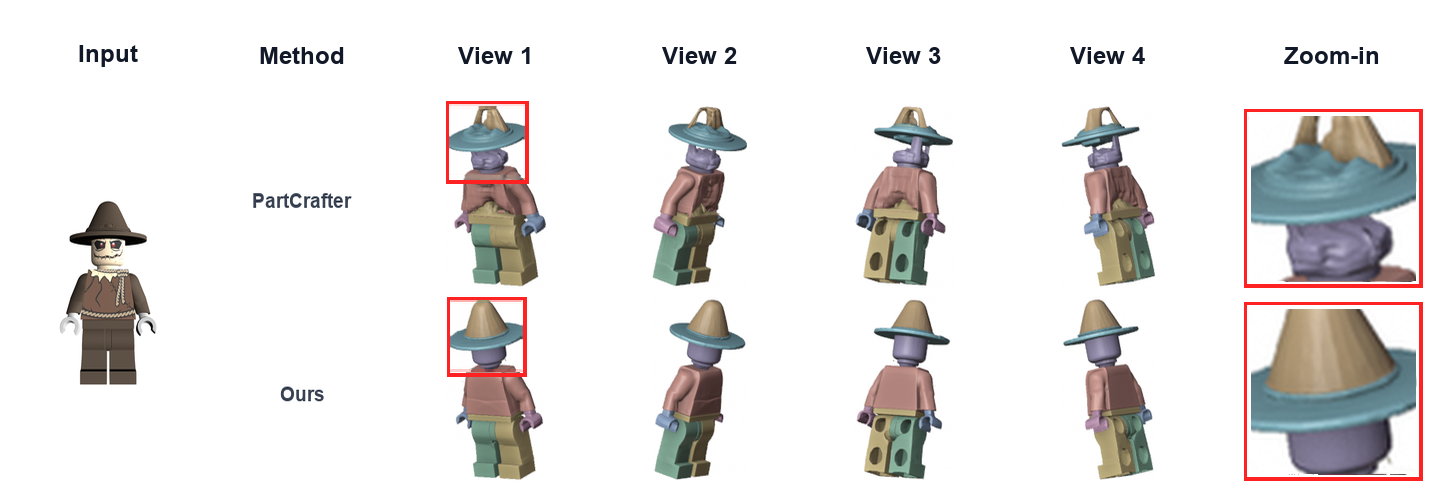
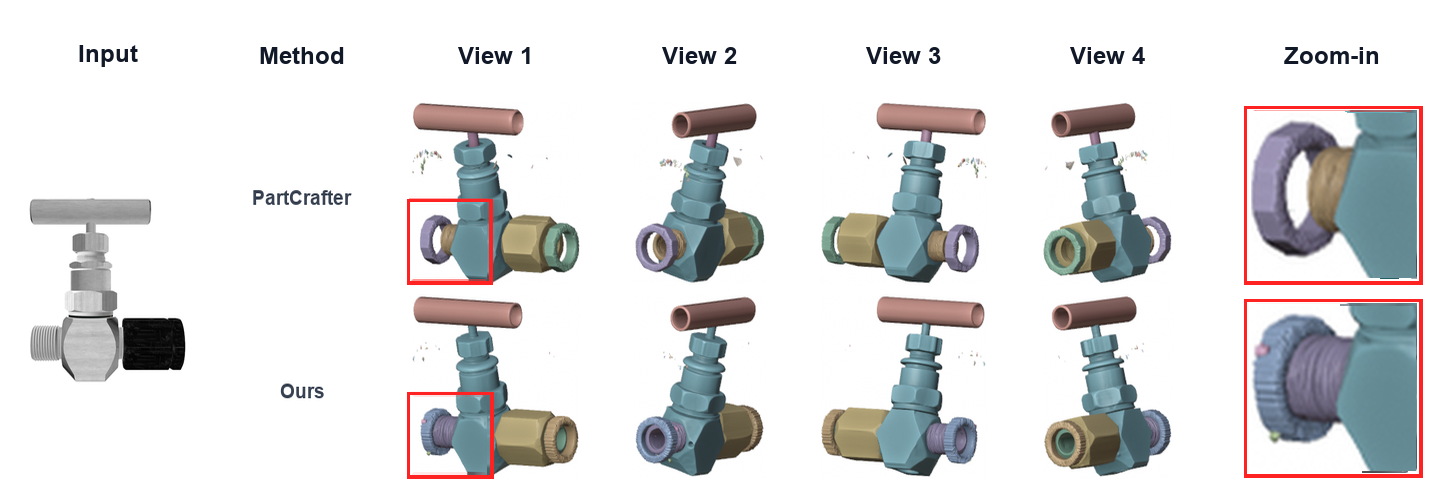
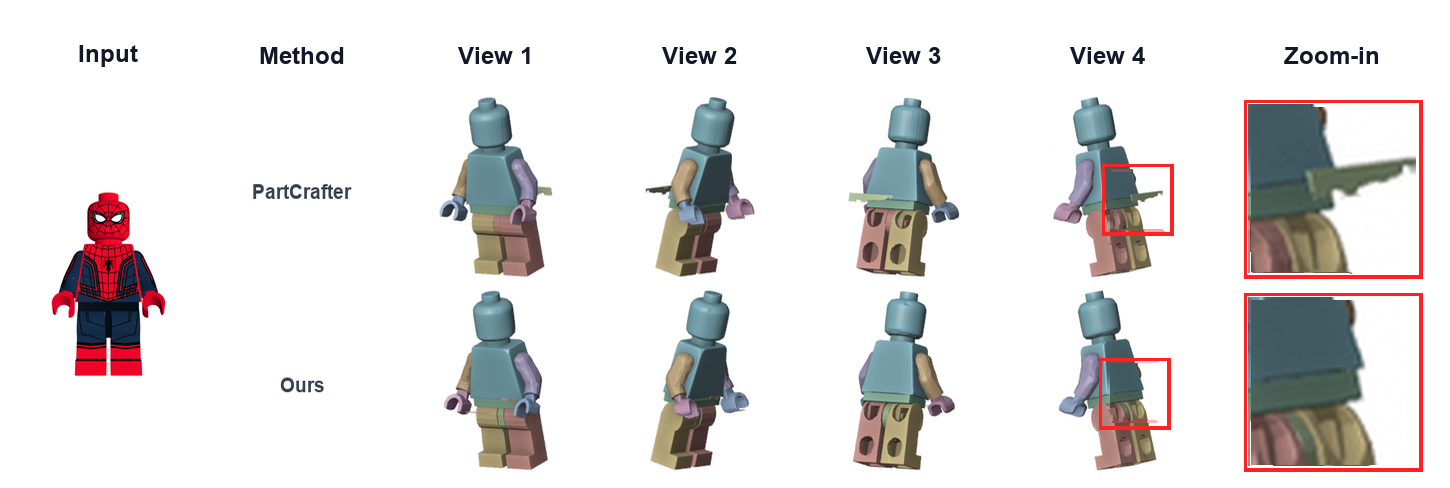
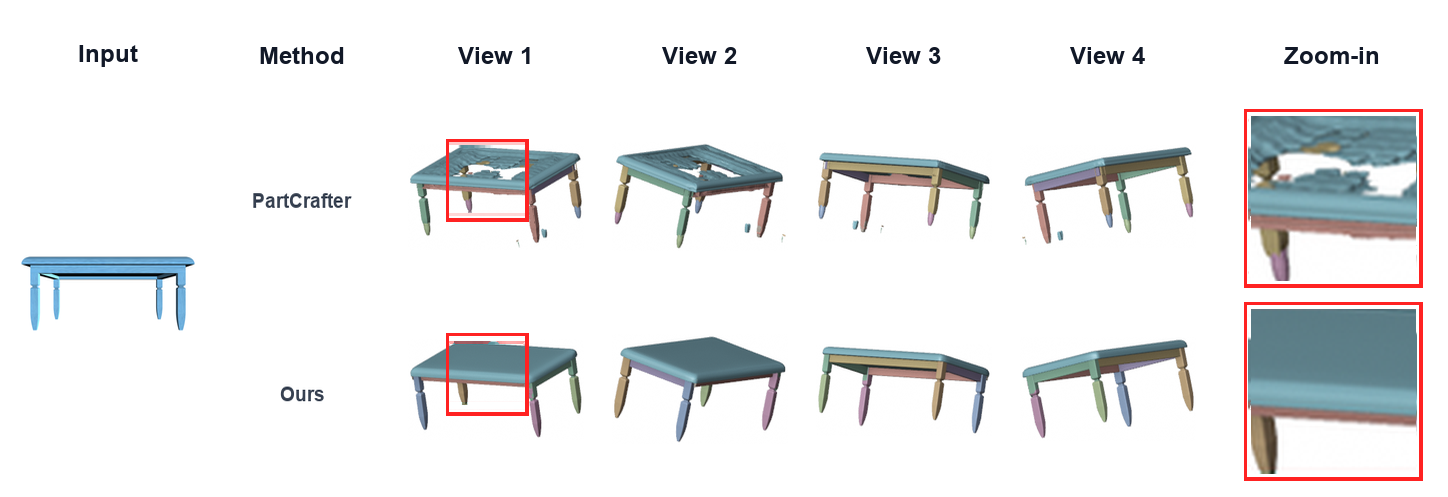
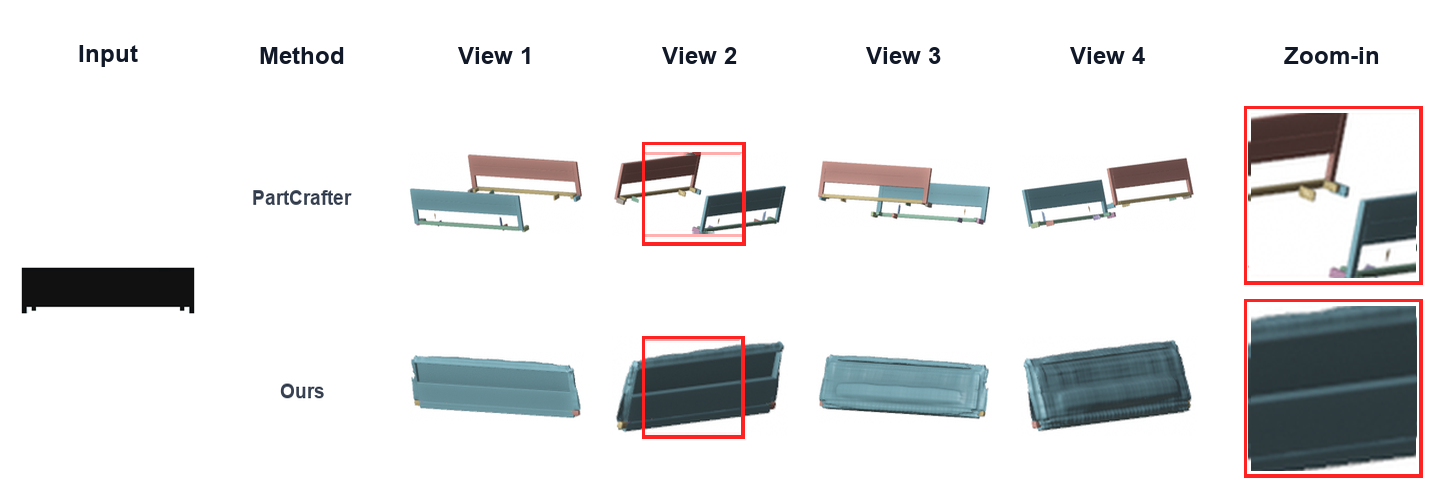
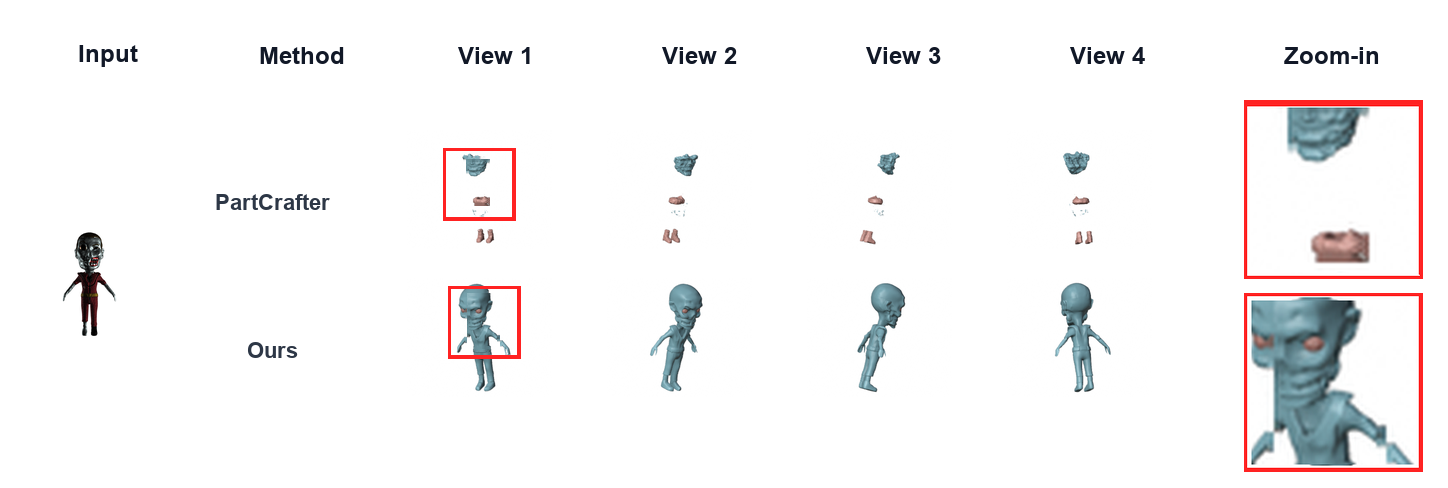
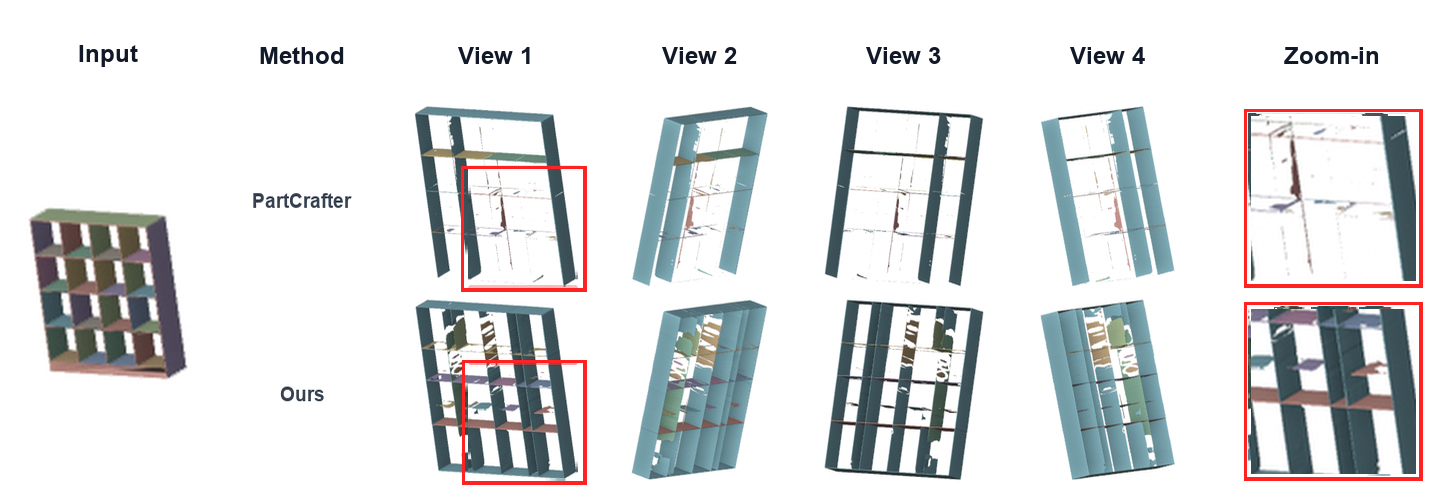
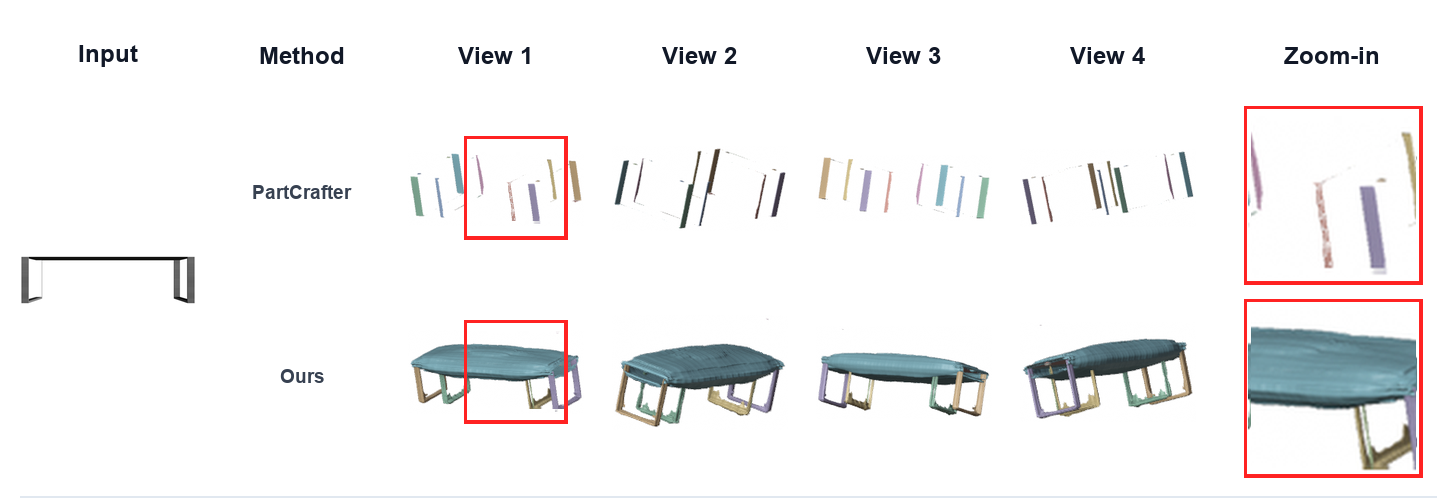
Part-aware generation on held-out inputs
On 2–8-part Objaverse objects, PartDPO improves all four metrics over pretrained PartCrafter and SFT.
Objaverse
| Setting | Obj-CD ↓ | Obj-FS ↑ | Part-CD ↓ | Part-FS ↑ |
|---|---|---|---|---|
| Pretrained | 0.2724 | 0.5680 | 0.2875 | 0.5453 |
| SFT | 0.2667 | 0.5751 | 0.2852 | 0.5509 |
| Ours | 0.2625 | 0.5881 | 0.2716 | 0.5707 |
Every part-count group
| Setting | Obj-CD ↓ | Obj-FS ↑ | Part-CD ↓ | Part-FS ↑ |
|---|---|---|---|---|
| 1 part · Pretrained | 0.2382 | 0.6366 | 0.2096 | 0.6949 |
| 1 part · SFT | 0.2243 | 0.6441 | 0.1890 | 0.7273 |
| 1 part · Ours | 0.2184 | 0.6603 | 0.2044 | 0.7020 |
| 2–4 parts · Pretrained | 0.2631 | 0.5909 | 0.2574 | 0.5986 |
| 2–4 parts · SFT | 0.2568 | 0.5945 | 0.2620 | 0.5955 |
| 2–4 parts · Ours | 0.2491 | 0.6121 | 0.2485 | 0.6237 |
| 5–8 parts · Pretrained | 0.2865 | 0.5332 | 0.3333 | 0.4646 |
| 5–8 parts · SFT | 0.2813 | 0.5463 | 0.3197 | 0.4846 |
| 5–8 parts · Ours | 0.2824 | 0.5520 | 0.3062 | 0.4912 |
| 2–8 avg. · Pretrained | 0.2724 | 0.5680 | 0.2875 | 0.5453 |
| 2–8 avg. · SFT | 0.2667 | 0.5751 | 0.2852 | 0.5509 |
| 2–8 avg. · Ours | 0.2625 | 0.5881 | 0.2716 | 0.5707 |
ABO
| Setting | Obj-CD ↓ | Obj-FS ↑ | Part-CD ↓ | Part-FS ↑ |
|---|---|---|---|---|
| Pretrained | 0.1520 | 0.7806 | 0.3204 | 0.4888 |
| SFT | 0.1409 | 0.8087 | 0.3062 | 0.4889 |
| Ours | 0.1382 | 0.8072 | 0.3215 | 0.4729 |
Every part-count group
| Setting | Obj-CD ↓ | Obj-FS ↑ | Part-CD ↓ | Part-FS ↑ |
|---|---|---|---|---|
| 1 part · Pretrained | 0.0978 | 0.8998 | 0.0975 | 0.9007 |
| 1 part · SFT | 0.0991 | 0.9066 | 0.1043 | 0.8935 |
| 1 part · Ours | 0.1007 | 0.8883 | 0.1015 | 0.8898 |
| 2–4 parts · Pretrained | 0.1520 | 0.7806 | 0.3204 | 0.4888 |
| 2–4 parts · SFT | 0.1409 | 0.8087 | 0.3062 | 0.4889 |
| 2–4 parts · Ours | 0.1382 | 0.8072 | 0.3215 | 0.4729 |
| 5–8 parts · Pretrained | — | — | — | — |
| 5–8 parts · SFT | — | — | — | — |
| 5–8 parts · Ours | — | — | — | — |
| 2–8 avg. · Pretrained | 0.1520 | 0.7806 | 0.3204 | 0.4888 |
| 2–8 avg. · SFT | 0.1409 | 0.8087 | 0.3062 | 0.4889 |
| 2–8 avg. · Ours | 0.1382 | 0.8072 | 0.3215 | 0.4729 |
ShapeNet
| Setting | Obj-CD ↓ | Obj-FS ↑ | Part-CD ↓ | Part-FS ↑ |
|---|---|---|---|---|
| Pretrained | 0.1814 | 0.7130 | 0.3262 | 0.4457 |
| SFT | 0.1751 | 0.7269 | 0.3270 | 0.4430 |
| Ours | 0.1833 | 0.7118 | 0.3344 | 0.4396 |
Every part-count group
| Setting | Obj-CD ↓ | Obj-FS ↑ | Part-CD ↓ | Part-FS ↑ |
|---|---|---|---|---|
| 1 part · Pretrained | 0.2092 | 0.6626 | 0.2094 | 0.6632 |
| 1 part · SFT | 0.2162 | 0.6411 | 0.2161 | 0.6401 |
| 1 part · Ours | 0.2276 | 0.6147 | 0.2294 | 0.6000 |
| 2–4 parts · Pretrained | 0.1828 | 0.7107 | 0.3115 | 0.4689 |
| 2–4 parts · SFT | 0.1807 | 0.7178 | 0.3099 | 0.4748 |
| 2–4 parts · Ours | 0.1816 | 0.7179 | 0.3199 | 0.4712 |
| 5–8 parts · Pretrained | 0.1795 | 0.7160 | 0.3456 | 0.4149 |
| 5–8 parts · SFT | 0.1677 | 0.7391 | 0.3497 | 0.4006 |
| 5–8 parts · Ours | 0.1854 | 0.7037 | 0.3537 | 0.3975 |
| 2–8 avg. · Pretrained | 0.1814 | 0.7130 | 0.3262 | 0.4457 |
| 2–8 avg. · SFT | 0.1751 | 0.7269 | 0.3270 | 0.4430 |
| 2–8 avg. · Ours | 0.1833 | 0.7118 | 0.3344 | 0.4396 |
What does the pairwise loss contribute?
The pairwise loss improves part geometry over reconstruction-only training in the matched Objaverse control.
Full ablation results
| Setting | Obj-CD ↓ | Obj-FS ↑ | Part-CD ↓ | Part-FS ↑ |
|---|---|---|---|---|
| F1 Pretrained | 0.2724 | 0.5680 | 0.2875 | 0.5453 |
| F2 Medium, recon. | 0.2650 | 0.5179 | 0.3001 | 0.4552 |
| F3 Medium, full | 0.1941 | 0.7036 | 0.2624 | 0.5488 |
| F4 Large, recon. | 0.2819 | 0.4878 | 0.3328 | 0.4061 |
| F5 Large, full | 0.2625 | 0.5881 | 0.2716 | 0.5707 |
The preference pairs matter
- Metric-guided pairs. The 50-object setting (363 pairs) gives the best Objaverse matched-part results within this group.
- Human ranking. Seven screened pairs improve all four Objaverse metrics over pretrained; 41 pairs do not.
- Pair ordering. Reversed labels or randomly ordered seeds weaken matched-part results in the large Objaverse setting.
Full pair-construction results
Bold: best in each column.
Objaverse
| Setting | Obj-CD ↓ | Obj-FS ↑ | Part-CD ↓ | Part-FS ↑ |
|---|---|---|---|---|
| Pretrained | 0.2724 | 0.5680 | 0.2875 | 0.5453 |
| Metric · 7 objects / 56 pairs | 0.2626 | 0.5328 | 0.3157 | 0.4545 |
| Metric · 50 objects / 363 pairs | 0.1986 | 0.6958 | 0.2542 | 0.5725 |
| Metric · 140 objects / 796 pairs | 0.2625 | 0.5881 | 0.2716 | 0.5707 |
| Human-ranked · 41 pairs | 0.5127 | 0.1745 | 0.5616 | 0.1285 |
| Human-ranked · 7 pairs | 0.2603 | 0.5854 | 0.2805 | 0.5573 |
| Synthetic crop · 30% | 0.3529 | 0.4127 | 0.3821 | 0.3398 |
| Synthetic crop · 50% | 0.3636 | 0.3721 | 0.4222 | 0.2836 |
| Labels reversed · 10% | 0.3848 | 0.3238 | 0.4336 | 0.2690 |
| Labels reversed · 30% | 0.3628 | 0.3709 | 0.4267 | 0.2858 |
| Labels reversed · 50% | 0.3738 | 0.3487 | 0.4480 | 0.2579 |
| Random replacement · 10% | 0.2461 | 0.5330 | 0.3122 | 0.4319 |
| Random replacement · 30% | 0.3542 | 0.3554 | 0.4398 | 0.2364 |
| Random replacement · 50% | 0.3635 | 0.3797 | 0.4009 | 0.3043 |
ABO
| Setting | Obj-CD ↓ | Obj-FS ↑ | Part-CD ↓ | Part-FS ↑ |
|---|---|---|---|---|
| Pretrained | 0.1520 | 0.7806 | 0.3204 | 0.4888 |
| Metric · 7 objects / 56 pairs | 0.3000 | 0.4528 | 0.3722 | 0.3437 |
| Metric · 50 objects / 363 pairs | 0.2233 | 0.6560 | 0.3104 | 0.4707 |
| Metric · 140 objects / 796 pairs | 0.1382 | 0.8072 | 0.3215 | 0.4729 |
| Human-ranked · 41 pairs | 0.4440 | 0.2215 | 0.5293 | 0.1531 |
| Human-ranked · 7 pairs | 0.1400 | 0.8021 | 0.3096 | 0.5006 |
| Synthetic crop · 30% | 0.3319 | 0.4355 | 0.4145 | 0.3072 |
| Synthetic crop · 50% | 0.3610 | 0.3950 | 0.4280 | 0.2945 |
| Labels reversed · 10% | 0.3678 | 0.3957 | 0.4562 | 0.2672 |
| Labels reversed · 30% | 0.4026 | 0.3161 | 0.4783 | 0.2384 |
| Labels reversed · 50% | 0.3996 | 0.3247 | 0.4822 | 0.2192 |
| Random replacement · 10% | 0.2267 | 0.6041 | 0.3287 | 0.4440 |
| Random replacement · 30% | 0.3549 | 0.2719 | 0.5075 | 0.1812 |
| Random replacement · 50% | 0.3147 | 0.3820 | 0.4057 | 0.2755 |
ShapeNet
| Setting | Obj-CD ↓ | Obj-FS ↑ | Part-CD ↓ | Part-FS ↑ |
|---|---|---|---|---|
| Pretrained | 0.1814 | 0.7130 | 0.3262 | 0.4457 |
| Metric · 7 objects / 56 pairs | 0.2843 | 0.4442 | 0.3612 | 0.3500 |
| Metric · 50 objects / 363 pairs | 0.2099 | 0.6500 | 0.2872 | 0.4688 |
| Metric · 140 objects / 796 pairs | 0.1833 | 0.7118 | 0.3344 | 0.4396 |
| Human-ranked · 41 pairs | 0.4942 | 0.1579 | 0.5557 | 0.1284 |
| Human-ranked · 7 pairs | 0.1725 | 0.7386 | 0.3267 | 0.4493 |
| Synthetic crop · 30% | 0.3681 | 0.3531 | 0.4490 | 0.2541 |
| Synthetic crop · 50% | 0.3514 | 0.3717 | 0.4346 | 0.2631 |
| Labels reversed · 10% | 0.3722 | 0.3478 | 0.4289 | 0.2645 |
| Labels reversed · 30% | 0.3804 | 0.3102 | 0.4560 | 0.2434 |
| Labels reversed · 50% | 0.3833 | 0.3178 | 0.4650 | 0.2194 |
| Random replacement · 10% | 0.2432 | 0.5240 | 0.3227 | 0.3975 |
| Random replacement · 30% | 0.3982 | 0.2512 | 0.5219 | 0.1458 |
| Random replacement · 50% | 0.4225 | 0.2552 | 0.4958 | 0.1892 |
BibTeX
@inproceedings{qin2026targetpart,
  title     = {Target-Part Preference Optimization for Part-Aware 3D Generation},
  author    = {Qin, Zishan and Li, Rui and Zhang, Zeyu and
               Kandanaarachchi, Sevvandi and Yao, Lina and Gong, Dong},
  booktitle = {Digital Image Computing: Techniques and Applications (DICTA)},
  year      = {2026}
}